
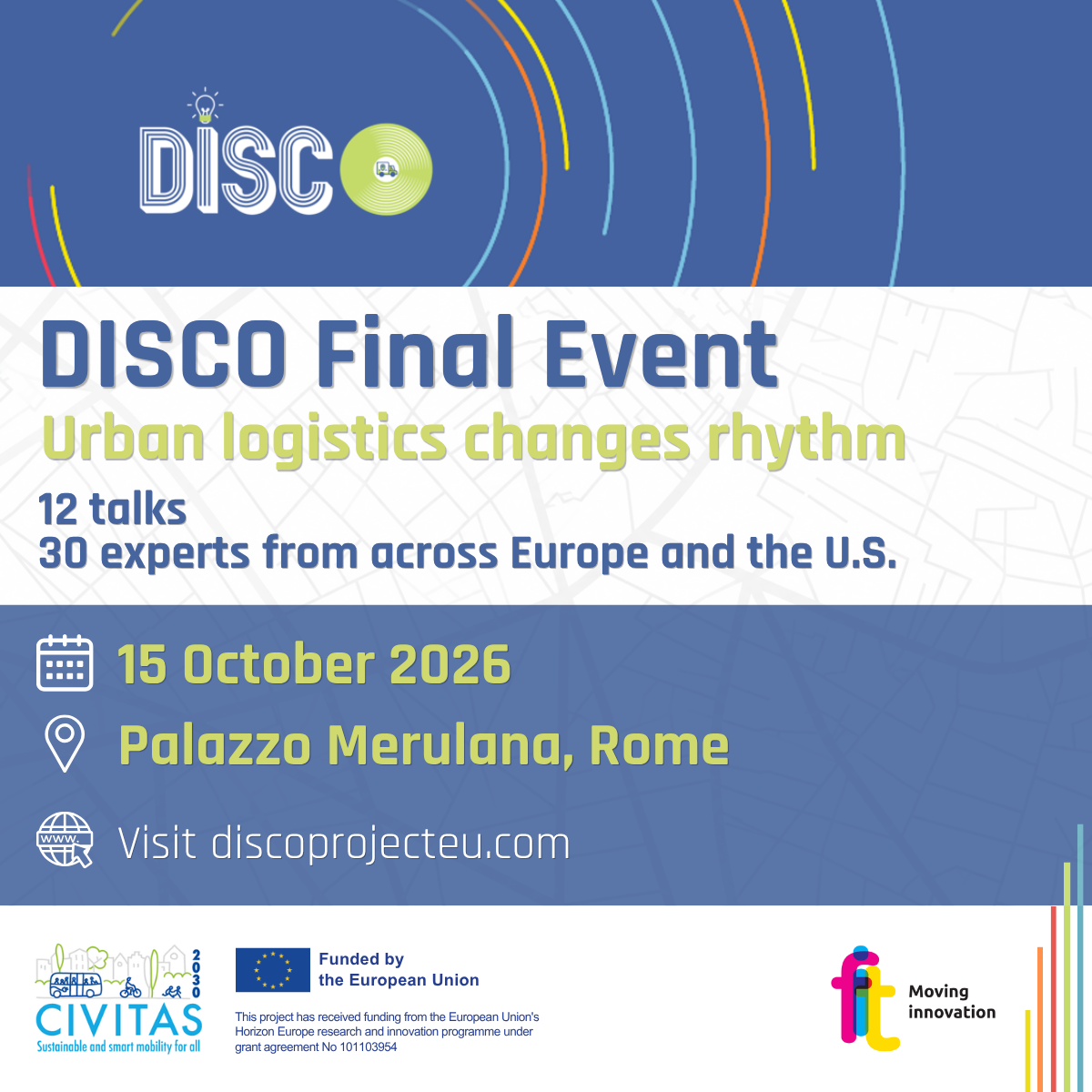
“Urban logistics changes rhythm”
The final event of the European project coordinated by FIT Consulting takes place in Rome
On 15 October 2026, at Palazzo Merulana in Rome, FIT Consulting presents “DISCO: THE FINAL EVENT — Urban Logistics Changes Rhythm,” the closing event of the DISCO European project, coordinated by the Italian company. After more than three years of work, the final conference will bring together representatives from cities, European institutions and companies from across Europe and the United States. 12 talks featuring 30 experts and institutional representatives will take the stage to share results, experiences and new perspectives on urban logistics in the digital age.
Launched in May 2023, the DISCO project was conceived and written by Paola Cossu, CEO of FIT Consulting, an Italian company founded in 1997 by Massimo Marciani, the company’s Chairman, and one of the first Italian companies to work systematically on sustainable mobility for people and goods. Funded by the European Commission under the Horizon Europe programme, DISCO brings together 48 partners — cities, universities, research centres and private companies — from across Europe, with the aim of developing new models for digital, collaborative and more efficient urban logistics, contributing to the EU’s decarbonisation and climate neutrality goals. The solutions developed by DISCO have involved 12 European cities and territories, including Copenhagen, Ghent, Helsinki, Barcelona, Padua and Thessaloniki, which have been transformed into real-world laboratories to test new ways of planning and managing goods, spaces, capacity and services.
But why DISCO?
Music has changed its model: from exclusive ownership to shared, flexible use, from physical formats to a universe of content available whenever it’s needed. What if urban logistics could do the same?
It is from this intuition that DISCO takes shape — Data-driven, Integrated, Syncromodal, Collaborative and Optimised urban freight meta-model. The project brings to urban logistics a shift that has already taken place in other sectors: digital technology doesn’t just make what already exists more efficient — it can change the way resources are known, made accessible and used.
In cities, space is a resource shared among multiple uses and users, but its real capacity is not always visible: spaces, infrastructure and assets may only be usable at certain times, they may remain underused, or they may hold untapped logistical potential. The challenge, then, is not simply to find new spaces for logistics, but to better understand the capacity a city already has, make it accessible, and activate it when and where needed — reconciling it with other uses and with the city’s real needs.
DISCO connects data, demand, spaces, capacity and services, turning isolated resources into connected, shareable components of an integrated urban logistics system. This also changes the way logistics is planned: no longer separate interventions, but a systemic vision that integrates real demand, available capacity and the needs of the city. Digitalisation, data sharing and collaboration thus become the levers of a logistics system that adapts to the city, rather than the other way around.
“Music has shown us how digital technology can radically change a model: from exclusive to shared, flexible use, making content available when and where it’s needed. With DISCO, we brought this same intuition to urban logistics. Our cities already have spaces, infrastructure and capacity that we often don’t fully know about or use. Digital technology can make them visible, connect them, and make them accessible when needed. But the real transformation runs even deeper: it means helping cities plan logistics as part of the urban system, based on real needs, and putting the city’s resources at the service of the community.”
– Paola Cossu, CEO of FIT Consulting and coordinator of the DISCO project
PROGRAMME
For FIT Consulting, the 15 October event represents an important opportunity to bring the results of 42 months of DISCO before an international audience, but also to look beyond the project itself: sharing what has been tested in the participating cities and opening a discussion on how to turn these experiences into new, replicable models for planning and managing urban logistics across Europe.
The day will open with remarks from Paola Cossu, followed by institutional greetings from Eugenio Patanè, Mobility Councillor for Roma Capitale, and by an institutional session moderated by Massimo Marciani, featuring, among others, Karen Vancluysen (Secretary General, POLIS), Giada Maio (Head of Energy, Climate, Mobility and Public Transport, ANCI), Theo Thuis (President, European Parking Association) and Andrea Condotta (President, ALICE).
During the morning, a panel led by Paola Astegiano, Head of Research and Innovation Unit at FIT Consulting, will bring together major European logistics operators — including UPS, La Poste and ACS Courier and Postal Services — alongside Roma Servizi per la Mobilità and the ITL Foundation, to discuss innovation in urban logistics and the optimal use of urban space. The afternoon will open with remarks from Anne Goodchild, Founding Director of the Urban Freight Lab at the University of Washington, who will present the role of digital technology in last-mile delivery. This will be followed by contributions from researchers at Politecnico di Milano, INLECOM and CERTH.
The afternoon will continue with two international round tables: the first, moderated by Raimondo Orsini (Fondazione Sviluppo Sostenibile), dedicated to new perspectives on the digitalisation of urban logistics, with the participation of representatives from the European Commission (DG Competition), NetZeroCities, and German and Greek consulting and research centres; the second, moderated by Thato Motloung (Breda University of Applied Sciences), focused on Physical Internet principles applied to logistics as a service, with contributions from operators and innovators active in Belgium, the United States and Greece. The day will close with the “DISCO Cities and Regions on Stage” session, in which partner cities will share firsthand the results achieved in their respective territories over the course of the project, followed by an award ceremony for all participating cities and a closing networking moment.
AGENDA